inquiry
dejar un mensaje
Si está interesado en nuestros productos y desea conocer más detalles, deje un mensaje aquí, le responderemos lo antes posible.
ENTREGAR
bandera
HOGAR

auto refinish paint

auto refinish paint

  • What Automotive Paint Distributors Should Look for When Choosing a New Refinish Brand
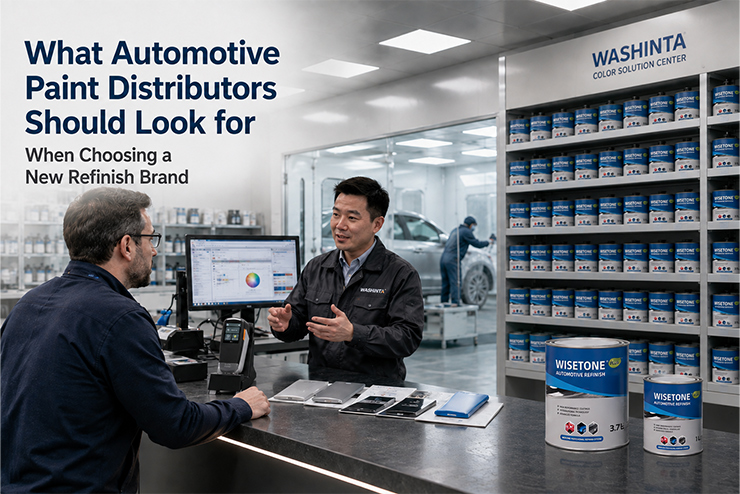
    What Automotive Paint Distributors Should Look for When Choosing a New Refinish Brand
    Sep 01, 2026
    Choosing a new automotive refinish brand is a major decision for any paint distributor. A new brand affects much more than the products on your shelves. It can influence your profit margins, inventory investment, technical workload, body shop relationships, and long-term competitiveness in your local market. For many years, distributors often focused on a few familiar questions: Is the quality good? Is the price competitive? Can the supplier deliver on time? Today, that is no longer enough. Vehicle colors are becoming more complex, Chinese EV brands are expanding into global markets, body shops expect faster repair cycles, and digital color-matching technology is becoming increasingly important. A competitive refinish brand therefore needs to provide more than paint. Here are eight key factors automotive paint distributors should evaluate before adding a new refinish brand to their portfolio. 1. Product Quality Must Be Consistent, Not Just Impressive Once Almost any supplier can prepare a good sample. The real test is whether the same performance can be maintained across different production batches and shipments. For a distributor, inconsistent quality can quickly become expensive. If clearcoat gloss changes between batches, basecoat color strength fluctuates, drying performance becomes unpredictable, or primers behave differently from one shipment to another, body shops will notice. And when body shops experience problems, they usually contact the distributor first. When evaluating a new brand, look beyond the first product demonstration. Consider: ·         Batch-to-batch consistency ·         Application stability ·         Drying performance ·         Gloss and appearance ·         Color accuracy ·         Hardness and durability ·         Performance under different climatic conditions ·         Compatibility across the complete refinish system Reliable quality protects more than the product—it protects your reputation with your customers. 2. Look for a Complete Refinish System Selling individual products may generate orders. Selling a complete system can build customers. A competitive automotive refinish brand should ideally cover the major stages of the repair process: Primers & Surfacers → Color System → Basecoats → Clearcoats → Hardeners → Thinners → Ancillary Products Why does this matter? For distributors, a complete system can increase the value of each customer account. Instead of selling only one clearcoat or primer, you can gradually supply a larger percentage of the body shop’s paint requirements. For body shops, it also simplifies purchasing, application, technical support, and troubleshooting. Before choosing a new brand, therefore, ask: Can this supplier help us build a complete refinish business, or are we simply adding several products to our warehouse? The difference is significant. 3. The Color System Can Determine Whether the Brand Succeeds In automotive refinishing, product quality gets a brand into a body shop. Color matching often determines whether it stays there. Modern automotive colors are becoming increasingly difficult to reproduce accurately. Metallic finishes, pearls, effect pigments, multi-layer colors, and new EV colors all create additional challenges for repair shops. A modern refinish brand should therefore have a strong color infrastructure behind it. Distributors should evaluate: ·         Number and quality of available color formulas ·         Frequency of formula updates ·         Coverage of local vehicle brands ·         Coverage of new and emerging vehicle manufacturers ·         Spectrophotometer compatibility ·         Digital formula retrieval ·         Formula correction capabilities ·         Technical support for difficult colors A large formula database is useful, but the number alone is not enough. The real question is: How quickly can the system help a body shop find a practical, accurate formula for the vehicle in front of them? That is what creates value at workshop level. 4. Pay Attention to Chinese EV Color Coverage This is becoming particularly important in many international markets. Chinese vehicle manufacturers are expanding rapidly outside China, bringing new models, new color codes, and new effect finishes into repair markets. For distributors, this creates both a challenge and an opportunity. If local body shops begin repairing more Chinese vehicles but existing refinish systems have limited formula coverage, the distributor that can provide better color solutions may gain an important competitive advantage. When evaluating a new refinish brand, ask the supplier: How quickly do you develop formulas for newly launched Chinese vehicle colors? A manufacturer based close to the Chinese automotive industry may have an advantage in identifying new models, collecting color data, developing formulas, and updating the database. As Chinese vehicles become a larger part of the global car parc, this capability could become increasingly valuable. 5. Calculate Distributor Profitability, Not Just Purchase Price One of the biggest mistakes when evaluating a new brand is comparing only the supplier’s price list. Purchase price matters, but distributor profitability depends on much more. Consider: Purchase Cost Freight & Import Costs Inventory Investment Technical Support Costs Marketing Costs Claims & Rework ↓ Actual Distributor Margin A product that costs 10% less is not necessarily more profitable if it creates more complaints, requires excessive inventory, or is difficult to sell. At the same time, a very expensive brand can limit your margin and make it harder to compete in price-sensitive segments. The ideal refinish brand should provide a healthy balance between: Quality + Market Positioning + Competitive Cost + Distributor Margin Distributors should also evaluate whether the supplier provides enough pricing flexibility to build sustainable margins for different levels of the distribution network. Your goal should not simply be to buy cheaper paint. Your goal should be to build a profitable refinish business. 6. Evaluate Inventory Requirements and Supply Flexibility Automotive refinish systems can involve hundreds of SKUs. Color toners, clearcoats, primers, hardeners, thinners, additives, and different packaging sizes can quickly create a significant inventory investment. Before introducing a new brand, distributors should understand: ·         Minimum order quantities ·         Initial stock requirements ·         Product shelf life ·         Packaging options ·         Lead times ·         Production capacity ·         Reorder flexibility ·         Fast-moving versus slow-moving SKUs This becomes especially important when introducing a new brand into a market. A distributor usually does not want to invest heavily in slow-moving inventory before demand has been established. A flexible manufacturer should understand this challenge and help its partners build an appropriate starting product portfolio. The best suppliers do not simply ask: “How much can you order?” They also ask: “What product combination makes sense for your market?” 7. Technical Support Is Part of the Product Automotive refinish coatings are not simple commodities. Body shops may need assistance with color matching, spray application, drying conditions, polishing, blending, product selection, or troubleshooting. If the manufacturer cannot provide effective technical support, much of that responsibility falls on the distributor. That increases your operating cost. A strong refinish brand should support distributors with: ·         Technical data sheets ·         Application guidance ·         Color-matching support ·         Product training ·         Troubleshooting ·         New product training ·         Formula updates ·         Digital technical materials ·         Remote technical communication Technical support becomes especially important when converting a body shop from another brand. Painters are accustomed to their existing products and processes. A smooth transition requires more than dropping new products at the workshop. Good technical support can significantly reduce the difficulty of converting customers. 8. Ask What the Supplier Will Do to Help You Grow the Market This is where a supplier relationship becomes a partnership. A distributor does not only need products. It needs tools to sell those products. When evaluating a new brand, ask whether the manufacturer can support: ·         Product catalogs ·         Technical documentation ·         Product images ·         Promotional materials ·         Social media content ·         Product demonstrations ·         Training materials ·         Exhibition support ·         Localized language materials ·         OEM/private-label packaging ·         Distributor development These resources can be particularly valuable for distributors launching a new brand. A manufacturer that understands marketing and distributor development can help shorten the time between importing products and generating real market demand. A Simple Distributor Evaluation Scorecard Before signing with a new automotive refinish brand, compare suppliers across the areas that directly affect your business. Evaluation Area Key Question Product Quality Is performance consistent across batches? Product Range Can we offer customers a complete refinish system? Color System Can body shops match colors efficiently? Vehicle Coverage Does the database cover the vehicles in our market? New EV Colors How quickly are new formulas developed? Profitability Is there enough sustainable distributor margin? Inventory Can we start and grow without excessive stock? Supply Are production and delivery reliable? Technical Support Can the supplier help solve real workshop problems? Marketing Support Will the manufacturer help us develop the market? Do not evaluate these factors independently. The strongest refinish brand is usually the one that provides the best overall business package. Think Beyond Paint: Choose a Business Platform The automotive refinish industry is changing. Body shops want faster turnaround. Painters want easier and more accurate color matching. Distributors want better margins. New vehicle brands are entering global markets. Digital tools are becoming increasingly important. This means the traditional supplier model— Manufacturer → Paint → Distributor → Body Shop —is evolving. A stronger model looks more like: Manufacturer + Products + Color Technology + Technical Support + Market Support ↓ Distributor ↓ More Competitive Body Shop Solution For distributors, this distinction matters. The right refinish brand should not only help you sell more paint. It should help you attract workshops, retain customers, improve profitability, and respond to changes in the vehicle market. WASHINTA: Supporting Automotive Refinish Distributors for Long-Term Growth Founded in 1997, Washinta Chemical Coating Co., Ltd. (WASHINTA) specializes in automotive refinish coatings and color solutions for international markets. WASHINTA provides a comprehensive automotive refinish portfolio covering color systems, basecoats, primers, clearcoats, hardeners, thinners, and related products. At the center of its color solution is WISETONE PLUS, an intelligent color-matching system developed to help distributors and body shops improve color retrieval and matching efficiency. The system combines: ·         100,000+ color formulas ·         Continuous formula database updates ·         Spectrophotometer-supported color matching ·         Intelligent formula retrieval ·         Support for a growing range of Chinese vehicle colors ·         Multi-language digital access For international distributors, WASHINTA can also provide OEM and private-label solutions, technical support, product training, customized marketing materials, and market-oriented product portfolio development. Our objective is simple: We don’t just want to supply paint. We want to help our distributors build stronger automotive refinish businesses. Looking for a New Automotive Refinish Brand? Whether you are an established automotive paint distributor, importer, regional wholesaler, or an entrepreneur developing a new refinish brand, choosing the right manufacturing partner can determine how competitive your business becomes. Evaluate more than price. Look at the products. Look at the color system. Look at the technical capabilities. Look at the margin opportunity. And most importantly, look at whether the manufacturer is prepared to grow with you. Interested in distributing WASHINTA products or developing your own automotive refinish brand? Contact WASHINTA to discuss distribution opportunities, OEM/private-label cooperation, automotive refinish products, and WISETONE PLUS color solutions. WASHINTA — Products. Color Technology. Partnership.
    LEER MÁS
  • How to Choose a Reliable Automotive Refinish Paint Manufacturer in China
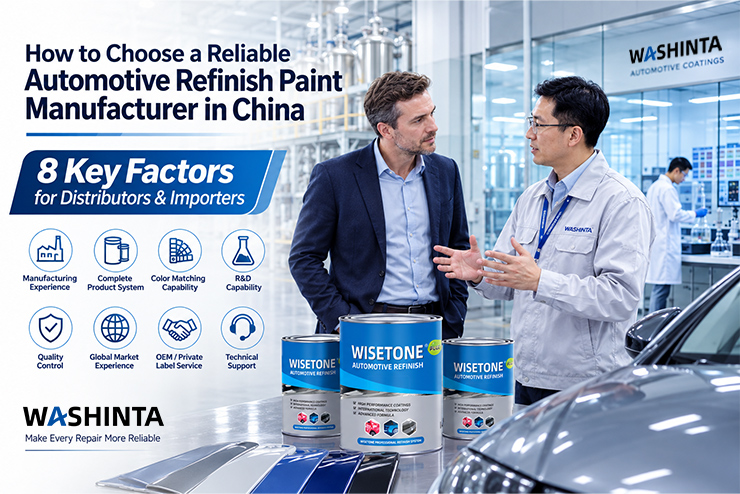
    How to Choose a Reliable Automotive Refinish Paint Manufacturer in China
    Aug 25, 2026
    China has become an important global manufacturing base for automotive refinish coatings. For distributors, importers, wholesalers, and automotive paint brands, sourcing from China can provide competitive pricing, flexible product solutions, and access to rapidly developing color-matching technologies. However, choosing the right supplier is about much more than comparing prices. Automotive refinish paint is a complete system involving color accuracy, coating performance, application stability, technical support, and long-term supply reliability. A good manufacturer should not simply provide paint—it should help its partners build a competitive and sustainable automotive refinish business. So, how can you identify a reliable automotive refinish paint manufacturer in China? Here are eight key factors to consider. 1. Manufacturing Experience and Industry Expertise Experience matters in automotive refinish coatings. Unlike many general industrial coatings, automotive refinishing requires consistent performance across different substrates, repair environments, climates, application techniques, and vehicle colors. When evaluating a manufacturer, consider: ·         How long has the company been producing automotive refinish coatings? ·         Does it operate its own manufacturing facility? ·         Does it have dedicated automotive refinish R&D capabilities? ·         Does it export to international markets? ·         Does it understand the requirements of professional body shops and paint distributors? An experienced manufacturer is generally better equipped to maintain product consistency, troubleshoot application problems, develop new products, and support distributors as their markets grow. 2. A Complete Automotive Refinish Product System A reliable supplier should offer more than a few popular clearcoats or primers. Professional distributors usually need a complete automotive refinish system that can cover the entire repair process, including: Color System → Primers & Surfacers → Basecoats → Clearcoats → Hardeners → Thinners → Ancillary Products Having a complete system provides several advantages. Products can be designed to work together, technical support becomes easier, inventory management is more efficient, and distributors can offer body shops a complete solution rather than individual products from multiple suppliers. When comparing manufacturers, therefore, evaluate the strength of the entire product portfolio—not only one or two products. 3. Strong Color Matching Capabilities Color matching is one of the most important factors in automotive refinishing. Modern vehicle colors are becoming increasingly complex. Metallics, pearls, effect pigments, multi-layer finishes, and new colors introduced by electric vehicle manufacturers can make accurate repair matching more challenging. A strong automotive paint manufacturer should therefore have more than a traditional formula database. Look for capabilities such as: ·         A continuously updated color formula database ·         Digital color retrieval ·         Spectrophotometer integration ·         Intelligent formula searching and correction ·         Color development for newly launched vehicle models ·         Technical support for difficult color matches The larger and more dynamic the vehicle market becomes, the more important these capabilities are. For distributors, a strong color system can also become a major competitive advantage when developing body shop customers. 4. R&D and Quality Control Capabilities Low price means little if product performance changes from batch to batch. Automotive refinish products require consistent viscosity, drying behavior, gloss, hardness, color accuracy, application performance, and durability. Before choosing a supplier, understand how the manufacturer manages quality. Important areas include: Raw Material Control Reliable manufacturers should have procedures for inspecting and controlling incoming raw materials. Production Process Control Mixing, dispersion, filling, and other production processes should follow standardized procedures. Laboratory Testing Products should be tested for relevant properties such as drying, gloss, adhesion, hardness, application performance, and storage stability. Batch Consistency For distributors, this is especially important. A product that performs differently between shipments can quickly damage customer confidence in the brand. A manufacturer with established R&D and quality-control systems is usually a safer long-term partner than a supplier competing mainly on price. 5. Certifications and International Market Experience Certifications provide useful evidence of a manufacturer’s quality-management and production capabilities, but certifications alone are not enough. International experience is equally important. A manufacturer serving overseas markets needs to understand: ·         Export documentation ·         Product labeling requirements ·         Packaging requirements ·         International logistics ·         Different climatic conditions ·         Distributor support ·         Market-specific product preferences Ask potential suppliers which markets they currently serve and how they support international customers. Experience working with overseas distributors can significantly reduce communication problems and make long-term cooperation easier. 6. OEM and Private Label Flexibility Many automotive refinish distributors want to develop their own brands rather than simply resell a manufacturer’s existing brand. If this is part of your strategy, evaluate the manufacturer’s OEM and private-label capabilities carefully. A capable partner should be able to support areas such as: ·         Product selection ·         Packaging customization ·         Label design ·         Product positioning ·         Different package sizes ·         Technical documentation ·         Marketing materials ·         Product portfolio development But flexibility should not mean sacrificing quality. The best OEM relationship is not simply: “Put my logo on your paint.” It should be: “Help me build a competitive automotive refinish product line for my market.” This difference becomes increasingly important as your distribution business grows. 7. Technical and After-Sales Support Automotive refinish coatings are technical products. Even a good product can produce poor results when the mixing ratio, thinner selection, spray technique, flash-off time, drying conditions, or polishing process is incorrect. For this reason, technical support should be part of your supplier evaluation. A reliable manufacturer should be able to assist with: ·         Product application ·         Color matching ·         Troubleshooting ·         Product training ·         Technical data ·         Formula support ·         New product introduction This is particularly important when entering a new market or launching a new brand. A supplier that responds quickly to technical problems can help distributors protect customer relationships and reduce unnecessary claims. 8. Think Beyond Price: Evaluate Long-Term Value Price is always important—but the cheapest quotation does not necessarily create the highest profit. Consider the total value of the partnership. For example, imagine Supplier A offers a slightly lower purchase price but provides limited color support, inconsistent batches, slow communication, and little technical assistance. Supplier B may have a slightly higher price but provides stable quality, a strong color system, regular formula updates, technical support, and reliable delivery. For a professional distributor, Supplier B may ultimately generate significantly more value. The real question should therefore not be: “Who offers the lowest price?” Instead, ask: “Which manufacturer can help us compete and grow in our market over the next five years?” A Practical Checklist for Evaluating Chinese Automotive Refinish Paint Manufacturers Before making a final decision, evaluate potential suppliers in these eight areas: Area What to Check Manufacturing Factory, production capacity, industry experience Product Range Complete automotive refinish system Color System Formula database, updates, digital matching R&D Laboratory, product development, technical team Quality QC procedures, batch consistency, certifications Global Experience Export markets and distributor experience Customization OEM, private label, packaging and documentation Support Training, color support and troubleshooting Ideally, request samples and conduct real application tests before making a large commercial commitment. A factory visit—either in person or through a detailed video inspection—can also provide valuable insight into the manufacturer’s production, laboratory, warehouse, and quality-control capabilities. WASHINTA: More Than an Automotive Paint Supplier Founded in 1997, Washinta Chemical Coating Co., Ltd. specializes in the development and manufacturing of automotive refinish coatings and color solutions for international markets. With decades of experience in automotive coatings, WASHINTA provides a comprehensive product portfolio covering color systems, basecoats, clearcoats, primers, hardeners, thinners, and related refinish products. Beyond coatings, WASHINTA continues to invest in digital color technology. Its WISETONE PLUS Intelligent Color Matching System combines a growing database of 100,000+ color formulas, digital color retrieval, spectrophotometer-supported matching, and continuous formula updates to help distributors and body shops improve color-matching efficiency. WASHINTA also supports international partners with: ·         Complete automotive refinish product systems ·         OEM and private-label solutions ·         Technical and color-matching support ·         Customized packaging and product portfolios ·         Distributor development support ·         Global export and logistics experience For distributors, importers, and automotive refinish brands, choosing a manufacturer is not simply a sourcing decision. It is a decision about the competitiveness of your business. Looking for an Automotive Refinish Paint Manufacturer in China? Whether you are looking to distribute an established automotive refinish system, develop your own private-label product line, or upgrade your current color-matching solution, WASHINTA can provide products, technology, and technical support tailored to your market. Talk to WASHINTA about automotive refinish coatings, OEM/private-label cooperation, or WISETONE PLUS color solutions. WASHINTA — Your Reliable Partner in Automotive Refinishing.
    LEER MÁS

dejar un mensaje

dejar un mensaje
Si está interesado en nuestros productos y desea conocer más detalles, deje un mensaje aquí, le responderemos lo antes posible.
ENTREGAR
Contáctenos: kay@washinta.com

HOGAR

PRODUCTOS

WhatsApp

CONTACTO